
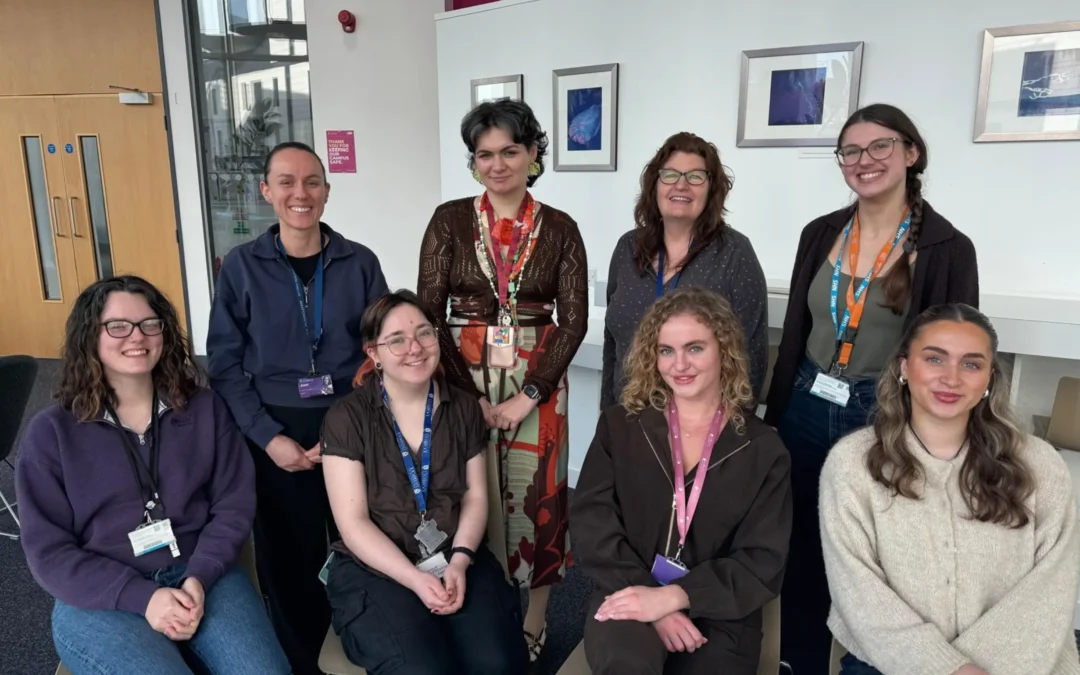
Back row (left to right): Juliette Hughes (Lecturer/PI), Ioana Comanici (1st year PhD student), Hazel Sutherland (PDRA), Rebecca Brown (3rd year PhD student) Front row (left to right): Harriet Willet (4th year PhD student), Jemma Clarke (Masters student), Daisy Quinn (2nd year PhD student), Megan Lewis (Masters student)
About International Women’s Day
International Women’s Day is an opportunity to recognise and celebrate the social, economic, cultural, and political achievements of women around the world while also serving as a call to action to advance gender equality. Across the AKU community, women play a vital role in improving understanding of the condition and supporting those living with it. At the AKU Society, our small team includes Hannah and Georga, alongside trustee Jess. We also work closely with many women at the National Alkaptonuria Centre (NAC) and with researchers at the University of Liverpool who are helping to drive progress in AKU research.
Following the International Day of Women and Girls in Science last month, and with International Women’s Day approaching on 8th March, we felt it was the perfect opportunity to highlight the voices of the women researchers we collaborate with. These scientists bring a wealth of knowledge, experience, and passion to their work.
To mark the occasion, we asked researchers at the University of Liverpool to share a little about their journey into science, what being a woman in STEM means to them, and what changes they hope to see for women in science in the future.
What inspired you to pursue science?
When we asked the team what first inspired them to pursue a career in science, a common theme quickly emerged: curiosity. For many researchers, the journey begins with a desire to understand how things work – from the human body to the wider universe – and to explore questions that don’t yet have answers.
Early curiosity and a fascination with the human body
For some researchers, the journey into science began with an early fascination with how the human body works.
For Juliette Hughes, that curiosity started in childhood. She was captivated by anatomy books and television programmes such as Bizarre ER, which sparked her interest in understanding how the human body works. This early curiosity eventually led her to study Human Anatomy at university and pursue a career in research.
Similarly, Megan Lewis’s path into science grew from an early interest in biology and the human body. Reflecting on her education, Megan recalls that biology was the subject that always made sense to her, sparking a long-standing interest that eventually led her to study biomedical science and explore musculoskeletal biology and diseases such as AKU.

A love of learning, solving problems, and making a difference
For others, the attraction of science lies in the challenge of asking questions and solving complex problems.
Daisy Quinn describes herself as someone who has always enjoyed learning and solving puzzles, which naturally drew her towards a field where there is always more to discover. From understanding how our bodies function to exploring the origins of the universe, she reflects that science remains “a giant mystery!”
A similar curiosity shaped Hazel Sutherland’s path into research. Her love of maths and biology at school laid the foundations for a career focused on understanding biological systems and applying that knowledge to real-world problems. As Hazel explains, her goal has always been “to try to make a difference to people with conditions such as Alkaptonuria.”
For Jemma Clarke, the appeal of science also lies in problem-solving, particularly when it can be applied to real-world challenges. She explains that she chose research because she enjoys tackling complex questions, “especially where that can be applied to real-world cases such as treating disease,” and hopes her work can contribute to addressing inequalities in medical research and healthcare.

Turning curiosity into meaningful research
For some researchers, the most rewarding part of science is the moment when abstract ideas begin to translate into real-world impact.
For Ioana Comanici, the appeal of science lies in turning curiosity into understanding. Drawn to the field by what she describes as “the pull of unanswered questions,” Ioana was fascinated by everything from the “vastness of the universe to the intricate processes within our cells that keep us alive”. The most rewarding moments, she explains, come when research connects directly to people’s lives – when work in the lab begins to deepen our understanding of conditions such as AKU.
Although each researcher’s journey into science is unique, their stories share common threads: curiosity, a passion for discovery, and a desire to understand the world in ways that can ultimately improve people’s lives.
What does being a woman in science mean to you?
Representation and inspiring the next generation
When reflecting on what it means to be a woman in science, many of the team spoke about the importance of representation and the opportunity to inspire others. For Ioana, being a woman in science also brings the opportunity to advocate for greater inclusion within research spaces.

Representation was also a theme raised by Daisy, who reflected on the lack of visible female role models in STEM while she was growing up. That experience has shaped how she views her own role today, hoping to encourage younger girls and show that “women can do anything they put their minds to.”

Similarly, Megan sees inspiring future generations as one of the most meaningful aspects of working in STEM. She believes that being a woman in science means “inspiring the younger generation of girls to show them that it is possible, inclusive, and most importantly fun!”
The idea of inspiring future generations was a recurring theme across many of the team. Juliette also highlighted the importance of visible role models in science saying that “science is for everyone!”

Balancing careers and supporting women in academia
Others reflected on how careers in science can intersect with life beyond the lab. Hazel spoke about the experience of balancing both professional and personal roles, sharing that being able to navigate both worlds has been deeply rewarding.
She also highlighted the impact of initiatives designed to support women in research and academia, noting that “I think Athena Swan has made some excellent changes for women with families.”
The Athena Swan charter is a UK framework that recognises and supports universities and research institutions working to advance gender equality in STEM. The charter encourages organisations to create more inclusive working environments and support the progression of women in research careers.
The University of Liverpool’s Institute of Life Course and Medical Sciences has actually been awarded an Athena Swan Gold Award!

Looking ahead
While progress has been made, many of the team emphasised the importance of continuing to encourage more girls and young women to pursue careers in STEM. Supporting the next generation is an important step towards building a more diverse and inclusive research community. Representation matters and seeing women working across all areas of science helps demonstrate that these careers are open to everyone.
This International Women’s Day, we celebrate the women contributing to AKU research, care, and advocacy, and thank them for the dedication, passion, and expertise they bring to this work every day – from the staff and trustees at the AKU Society, to the team at the NAC and the researchers at the University of Liverpool.

We would like to thank the researchers at the University of Liverpool who kindly shared their insights and experiences for this blog.
University of Liverpool staff:
Dr Juliette Hughes: https://www.liverpool.ac.uk/people/juliette-hughes
Dr Hazel Sutherland: https://www.liverpool.ac.uk/people/hazel-sutherland