
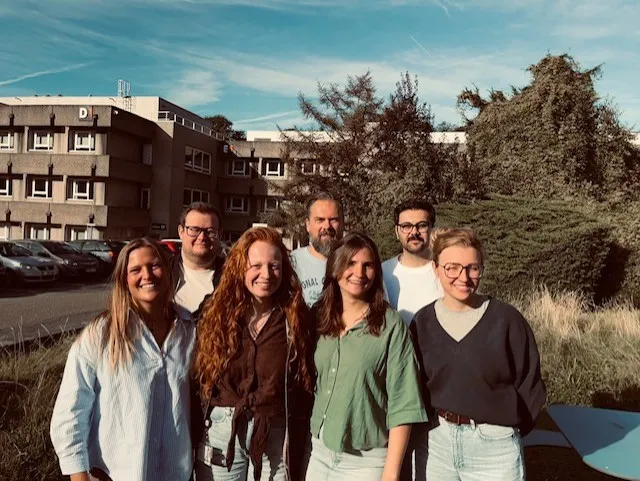
When I joined the Liver Therapy and Evolution (LiTE) team, part of the In Vitro Toxicology and Dermato-Cosmetology (IVTD) research group, at the Vrije Universiteit Brussel in 2019, I had just completed my degree in Pharmaceutical Sciences, with a focus on Drug Development. I was taking my first steps as a researcher, and the EvolvAKUre project immediately sparked my interest. It offered me the opportunity to work towards treatments that address the underlying cause of AKU, a rare disease for which better options are still needed.
Funded by the Research Foundation Flanders (FWO) and led by Professor Joery De Kock at the Vrije Universiteit Brussel, EvolvAKUre brought together researchers with complementary expertise. These included Professor Ulrich Schwaneberg and his team at RWTH Aachen University, as well as Professors Jim Gallagher, George Bou-Gharios and Lakshminarayan Ranganath at the University of Liverpool. This close international collaboration was essential to everything we achieved.
At the time, I could not have imagined how much this project would shape me. Over the years, I grew into a more independent researcher and became deeply committed to AKU research. Knowing that patients and families are waiting for further progress has given my work meaning far beyond the laboratory.
Where the project began
In people with AKU, an enzyme called homogentisate 1,2-dioxygenase (HGD) does not function properly. Without this enzyme, a substance called homogentisic acid (HGA) builds up in the body and gradually causes damage, particularly to the joints and cartilage.
Nitisinone (NTBC) is the main treatment currently available for AKU. It has been an important step forward because it greatly reduces the amount of HGA produced by the body. However, it does not restore HGD function and requires lifelong treatment and dietary management. The EvolvAKUre project explores a different approach: restoring the missing enzyme function and addressing the disease at its source.
One possible way to do this is through gene therapy. This involves delivering a healthy copy of the HGD gene to the liver, allowing liver cells to produce the missing enzyme. However, it remains difficult to reach enough liver cells safely, especially in humans.
The idea behind EvolvAKUre is therefore to develop an HGD enzyme that works better. If the enzyme produced by each treated liver cell is more effective, the gene may need to reach fewer cells. Ultimately, this could help make gene therapy safer and more effective.
How the research developed
Before trying to improve the HGD enzyme, we first wanted to know whether restoring it in the liver could reduce HGA. For this part of the project, we worked closely with researchers at the University of Liverpool, who provided the AKU mouse model and helped us analyse samples from the study. We delivered a healthy copy of the human HGD gene to the liver of these mice, and the results were encouraging: HGA levels in the blood fell to almost the same levels as in healthy mice.
This was an important first step, as it showed that restoring HGD in the liver could work. However, delivering enough of the gene safely remains challenging, particularly in humans. Our results therefore showed both the potential of this approach and why further improvements are needed before it could become a treatment for patients.
We therefore returned to the main idea behind EvolvAKUre: developing an HGD enzyme that works better. For this work, we collaborated with Professor Ulrich Schwaneberg and his team at RWTH Aachen University, who shared their expertise in directed protein evolution. This process is inspired by evolution in nature: we created and tested many slightly different versions of HGD to find one that worked better. Together, we identified an enzyme that was more active than the natural version.
This improved enzyme could make future treatments more efficient by allowing each treated liver cell to break down more HGA. Much more research is still needed, but it gives us a promising starting point for developing safer and more effective treatments.
An idea of my own
As my PhD progressed and I learned more about HGD, I began to wonder whether there might be another way to help people with AKU. Some patients still produce HGD, but their genetic change makes the enzyme too fragile to work properly.
I wondered whether a medicine could stabilise this fragile enzyme and restore some of its function. This type of treatment is known as a pharmacological chaperone: rather than replacing HGD, it helps the enzyme already present in the body work better.
This idea was not part of my original PhD plan, but as I developed as a researcher, it became a direction that I was eager to explore. I therefore developed a separate project proposal, called FixAKUre, and received funding from the Willy Gepts Fund of UZ Brussel to investigate it.
In our first laboratory experiments, we tested medicines that are already approved by the FDA for other diseases. We identified one compound that partially restored the function of HGD affected by one specific genetic change that causes AKU. Because this medicine is already used for another disease, information about its use and safety in humans is already available, which provides a useful basis for further research.
These findings are still at an early stage. We now need to determine whether the medicine also works in human liver cells and whether it could help people with other AKU-causing genetic changes. Its most suitable dose and safety would also need to be studied specifically for AKU. To help take this work further, we have also started a collaboration with Professor Óscar Millet and his team at CIC bioGUNE in Bilbao, who have experience in developing pharmacological chaperones for rare diseases.
Nevertheless, this finding opened another possible path towards treatment. For some patients, it may one day be possible to support the HGD enzyme their body already produces, rather than provide them with a new copy of the gene.

What does this mean for patients?
By the end of my PhD, we had found several possible ways to restore HGD function. We showed that gene therapy can strongly reduce HGA in an AKU mouse model. We developed an improved HGD enzyme that may make future therapies more efficient. We also found an early indication that a medicine might help certain forms of HGD work better.
None of these approaches is ready to be used in patients, and it is not yet possible to say whether or when they will lead to a new treatment. Further research is needed to understand how well they work and, most importantly, whether they can be used safely.
What gives me hope is that we now have several paths to explore. They approach AKU in different ways, but they share the same goal: restoring the HGD function that patients are missing.
Continuing the journey
My PhD has now ended, but fortunately the research will continue. I have received a two-year VLAIO Innovation Mandate to investigate how the most promising findings could be developed further and brought closer to a treatment for patients.
When I started in 2019, I mainly saw an exciting scientific challenge. Today, I also see the people behind that challenge. The project has made me passionate about AKU research and shown me how meaningful it is to work towards better options for people living with a rare disease.
Developing a therapy is a long journey, and research does not always progress as quickly as patients and researchers would wish. I cannot promise where each of these paths will lead. What I can say is that my PhD has given us valuable starting points, and I am grateful for the opportunity to continue building on them.
None of this work would have been possible without the support of the entire LiTE team and our collaborators. I am deeply grateful for their guidance, expertise and encouragement throughout the different stages of this project, and for sharing both the successes and the inevitable challenges that come with research.
Most importantly, I am grateful to the AKU community. Your experiences remind us why this research matters and continue to motivate us to move forward.